The challenge presents us with some files, the most important of which is chal.c. It mostly performs basic rule validation and parsing, and if the checks are successful, it prints the flag.
We are asked for a 16-digit hexadecimal string. The program validates both the length and the characters, checks if the hex string contains the substring deadbeef, parses the string as a 64-bit unsigned integer, copies the raw bytes of that integer into a double (floating-point value), and checks if it is a NaN (Not a Number). If all the checks pass, we get the flag.
To get the flag, we must create an input that satisfies all the checks, which means we need to create a NaN that contains the substring deadbeef in its hexadecimal representation. To do so, we first need to understand how NaN values and floating-point numbers in general are represented in memory.
This trick relies on the target environment using IEEE 754 binary64 for double and on the program interpreting the parsed integer’s bit pattern as that double representation. In practice, that is exactly what the challenge environment does.
How IEEE 754 doubles work
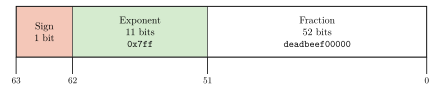
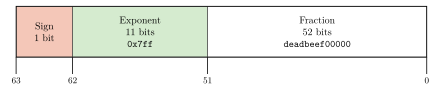
To solve the challenge, we need to look at how double-precision floating-point numbers are represented. The common representation for floating-point numbers is IEEE 754 binary64, usually called a double in C. It uses 64 bits split into three fields:
1sign bit11exponent bits52fraction bits, which are used to form the significand
For normal finite values, the exponent field and fraction field work together to represent a real number. But there are also special cases that the standard defines. The important rules are:
- if the exponent is all
1s and the fraction field is all0s, the value is infinity - if the exponent is all
1s and the fraction field is not all0s, the value is NaN - if the exponent is all
0s and the fraction field is not all0s, the value is subnormal - if the exponent is all
0s and the fraction field is all0s, the value is zero
So the important insight is that there is not just a single NaN value. There are many different bit patterns that represent NaN, as long as the exponent is all 1s and the fraction field is not all 0s. This means we can use the fraction field to store 52-bit data, including the substring deadbeef that the challenge requires.
There is one more small detail: NaNs can be quiet NaNs or signaling NaNs. In binary64, the most significant bit of the fraction field is commonly used to distinguish them; when that bit is set, the value is a quiet NaN. Our value starts the fraction field with d (1101 in binary), so that bit is set, making the chosen value 7ffdeadbeef00000 a quiet NaN.
Crafting the NaN
Now we just need to build a 64-bit value that satisfies what we just said. To make it easier, we can simply encode 0xdeadbeef and pad it with 0s to fill the 52-bit fraction field. Any other non-zero value would work as well, as long as it contains the required substring.
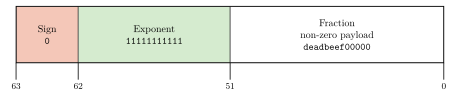
The sign bit does not matter for NaN, so we can set it to 0. If we wanted a negative NaN, the sign bit could be 1 instead.
Solution
Now, with the number ready, we can execute the local and remote binaries to get the flag. The input we need to provide is the hexadecimal representation of the NaN we just crafted, which is 7ffdeadbeef00000.
Locally, we can confirm that this satisfies the challenge binary:
$ ./chal
Send 16 hex digits.
> 0x7ffdeadbeef00000
Alpaca{REDACTED}
The
0xprefix is already printed to stdout by the binary, so we just need to input the hex digits after it.
The same input works against the remote service:
$ nc 34.170.146.252 60060
Send 16 hex digits.
> 0x7ffdeadbeef00000
Alpaca{IEEE 754 is the standard for floating-point arithmetic}
Conclusion
This was a fun little challenge. More than a “cybersecurity” challenge, it was a “computer science” challenge, which is something I enjoy too. Even so, there could be some security implications to this kind of thing. Maybe not exactly this case of checking a NaN, but the general idea of creating “valid” data in a way that hides information or a payload in its binary representation could be used in some kind of obfuscation or evasion technique. There are also some specific security implications of NaNs, such as the NaN-boxing technique used in some JavaScript (like V8) engines to represent different types of values in a single 64-bit word, which relies on the fact that there are many different NaN bit patterns available.
Greetings
As always, thanks to the AlpacaHack team for hosting these daily challenges, and thanks to pppp4649 for creating this one. It is a clean little floating-point exercise, and I always enjoy challenges where the entire solve depends on reading a binary layout carefully.
References
- The IEEE 754 Format: https://mathcenter.oxford.emory.edu/site/cs170/ieee754/