In 2Blue2Hen, we are given a Minecraft 1.12 screenshot with a visible bedrock floor pattern, and we are asked to find the coordinates where the player who took the screenshot is standing. The final flag is of the following form UDCTF{X_Y_Z}, where X, Y, and Z are the block coordinates of the block the player is standing on.
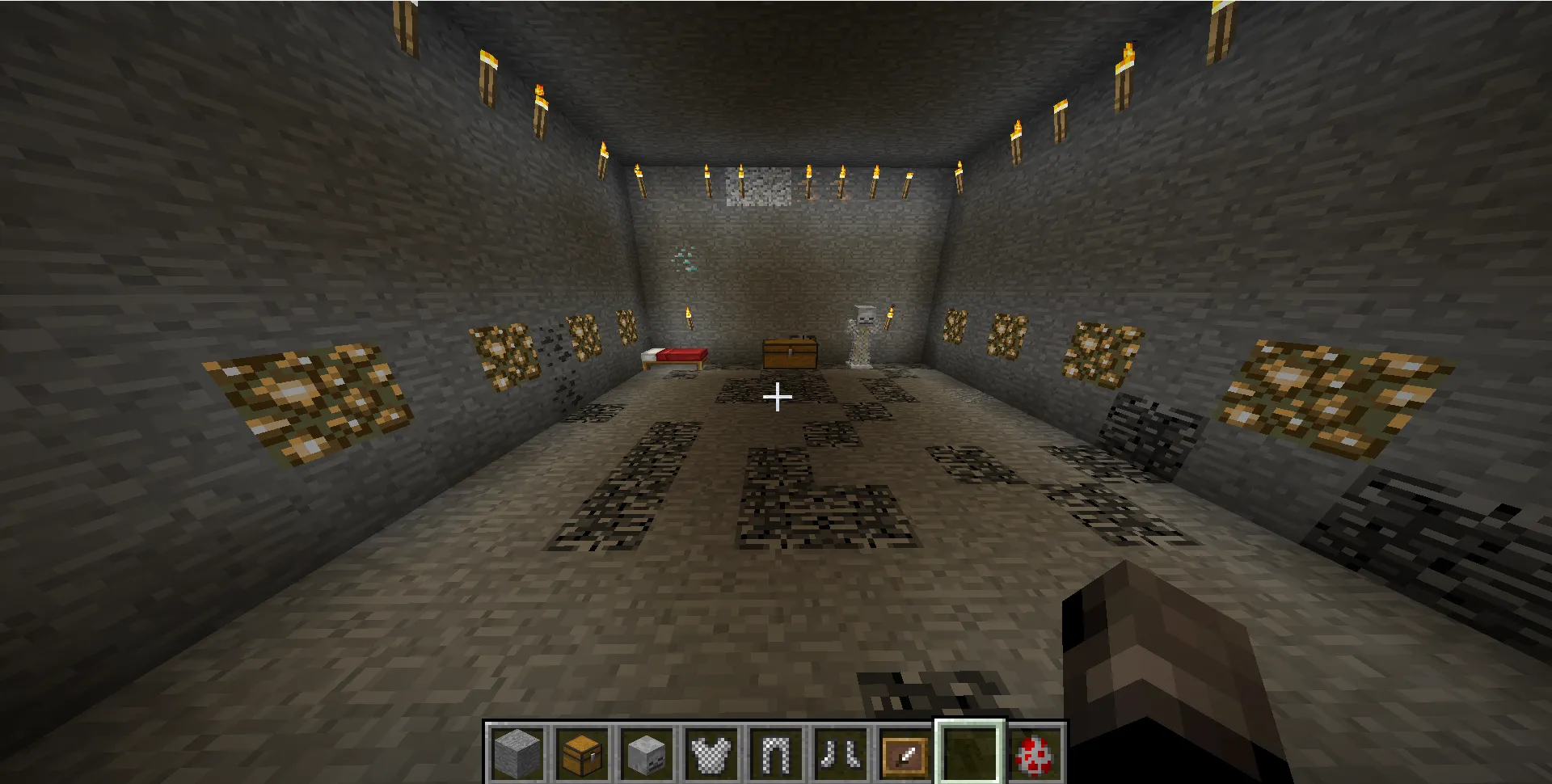
The fact that the floor is made of bedrock is a crucial hint. Bottom bedrock generation in Minecraft 1.12 is deterministic from chunk coordinates and does not use the world seed, and we know the bounds to search ( in X and Z). This means we can brute-force search for the location of the visible floor pattern by regenerating the bottom bedrock layers for each possible location and checking whether they match the screenshot.
Getting the pattern
First we need to get the pattern. For that we can simply check the image, create an imaginary grid, and write it down in a spreadsheet. The extracted pattern looked like this:
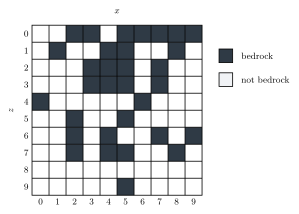
An important and relevant note for the following steps is that there are bedrock blocks in the first layer of the walls, so we know two things from this:
-
The visible floor may correspond to a lower bedrock layer rather than the highest generated one, so we should not only search one Y layer. We should search for the lower layers too ( and maybe even ), instead of assuming the visible pattern must be at the top of the bedrock stack.
-
When performing this kind of attack we usually benefit from knowing the orientation at which the player took the screenshot and its position relative to the chunk bounds. In this case the pattern is only and we have no reference for which cardinal direction the player is looking at, so we have to take this into account when performing the exhaustive search.
Finding the location
Now we need to actually find the location of this pattern. As we said earlier, bottom bedrock generation in Minecraft 1.12 is deterministic from chunk coordinates, so we can simply regenerate the bedrock pattern. Thankfully this is a well known problem and there is a deep understanding of how bedrock is generated in Minecraft, so we can implement the bedrock generator and then brute-force search for the pattern. I used this gist as a reference and implemented the scanner in C with MPI to split the exhaustive search across multiple processes.
The main point is that we need to rebuild the bottom bedrock layers for each possible block coordinate and check if the pattern matches. We also need to take into account the 8 possible orientations of the pattern (4 rotations and 4 reflections) to make sure we don’t miss any possible match. This is not limited to a single chunk: a pattern can cross chunk boundaries depending on its starting block.
Solver logic
The solver is basically a distributed pattern matcher over regenerated bedrock. Instead of loading a Minecraft world, each MPI rank computes the same pseudo-random bedrock decision Minecraft 1.12 makes for each chunk, caches those chunk masks, and then scans a shard of the extracted pattern over the search bounds.
We can represent the extracted floor as a binary grid, where 1 means bedrock and 0 means not bedrock:
static int grid[10][10] = {
    {0,0,1,1,0,1,1,1,1,1},
    {0,1,0,0,1,1,0,0,1,0},
    {0,0,0,1,1,1,0,1,0,0},
    {0,0,0,1,1,1,0,1,0,0},
    {1,0,0,0,0,0,1,0,0,0},
    {0,0,1,0,0,1,0,0,0,0},
    {0,0,1,0,1,0,0,1,0,1},
    {0,0,1,0,1,1,0,0,1,0},
    {0,0,0,0,0,0,0,0,0,0},
    {0,0,0,0,0,1,0,0,0,0},
};
For each candidate position, the scanner has to try all possible ways the screenshot grid could map onto world coordinates. These are the 4 rotations plus the 4 mirrored versions:
static int transform_point(int t, int x, int z, int *ox, int *oz) {
    switch (t) {
    case 0: *ox = x;         *oz = z;         break; // identity
    case 1: *ox = 9 - z;     *oz = x;         break; // rot90
    case 2: *ox = 9 - x;     *oz = 9 - z;     break; // rot180
    case 3: *ox = z;         *oz = 9 - x;     break; // rot270
    case 4: *ox = 9 - x;     *oz = z;         break; // flip x
    case 5: *ox = x;         *oz = 9 - z;     break; // flip z
    case 6: *ox = z;         *oz = x;         break; // transpose
    case 7: *ox = 9 - z;     *oz = 9 - x;     break; // anti-transpose
    default: return 0;
    }
    return 1;
}
The expensive part is bedrock lookup, so the solver first precomputes compact bitmasks for every chunk that could be touched by the search. The generation is driven by Java’s 48-bit LCG, seeded only from the chunk coordinates.
#define MASK48 ((1ULL << 48) - 1ULL)
#define MUL 25214903917ULL
#define ADD 11ULL

static inline uint64_t java_seed(int64_t seed) {
    return ((uint64_t)seed ^ 0x5DEECE66DULL) & MASK48;
}
The full source is omitted here, but helpers such as lcg_pow, apply, jump_y, and jump_col only advance Java’s LCG by precomputed offsets so the scanner can jump directly to the random value for a given local column and Y layer. With those jumps initialized, the per-chunk mask generation from search_bedrock.c looks like this:
uint64_t start = java_seed(
    (int64_t)cx * 341873128712LL +
    (int64_t)cz * 132897987541LL
);

for (int lz = 0; lz < 16; lz++) {
    for (int lx = 0; lx < 16; lx++) {
        for (int y = 1; y <= 4; y++) {
            uint64_t sy = apply(jump_y[y - 1], col_seed);
            int val = (int)(sy >> 17) % 5;
            if (y <= val) {
                chunks[chunk_index(cx, cz)].row[y - 1][lz] |= (uint16_t)(1U << lx);
            }
        }
        col_seed = apply(jump_col, col_seed);
    }
}
After that, checking a candidate is cheap. The MPI part is intentionally simple: rank r handles every size-th X coordinate, so the ranks do not need to communicate while searching. For this run, the scanner searched min_x = -10000, max_x = 10000, min_z = -10000, max_z = 10000, and Y layers 1..4. For each candidate, the scanner transforms each bedrock cell from the screenshot into world-relative coordinates, looks it up in the precomputed chunk masks, and rejects the candidate as soon as one required bedrock block is missing. Only surviving candidates get a full 100-cell comparison against both bedrock and non-bedrock cells:
for (int x = min_x + rank; x <= max_x; x += size) {
    for (int z = min_z; z <= max_z; z++) {
        for (int y = 1; y <= 4; y++) {
            for (int t = 0; t < 8; t++) {
                int ok = 1;
                for (int i = 0; i < pcount[t]; i++) {
                    Pt p = positives[t][i];
                    if (!is_bedrock_fast(x + p.dx, y, z + p.dz)) {
                        ok = 0;
                        break;
                    }
                }

                if (ok) {
                    int full = 0;
                    for (int gz = 0; gz < 10; gz++) {
                        for (int gx = 0; gx < 10; gx++) {
                            int tx, tz;
                            transform_point(t, gx, gz, &tx, &tz);
                            int have = is_bedrock_fast(x + tx, y, z + tz);
                            if (have == grid[gz][gx]) full++;
                        }
                    }

                    printf("rank=%d positive_match full=%d/100 x=%d y=%d z=%d transform=%s\n",
                           rank, full, x, y, z, tname(t));
                }
            }
        }
    }
}
Running it gives us:
mpicc -O3 -march=native search_bedrock.c -o search_bedrock
mpirun -np 8 ./search_bedrock
...
rank=2 positive_match full=100/100 x=1370 y=3 z=490 transform=rot180This means the pattern was found with its matched origin at world/block coordinates (1370, 3, 490), with the screenshot grid rotated 180 degrees before comparing it to the world. In other words, for a screenshot-grid cell (gx, gz), the corresponding world block is:
world_x = 1370 + (9 - gx)
world_y = 3
world_z = 490 + (9 - gz)
So the matched patch occupies block X 1370..1379, block Y 3, and block Z 490..499. These are block coordinates, not chunk coordinates. The block-coordinate origin (1370, 490) is in chunk (floor(1370 / 16), floor(490 / 16)) = (85, 30).
This is the only candidate that matches the pattern, so we can be confident that this is the correct world area.
Getting the exact coordinates
At this point, we have a single candidate that localized us to a small area of the map, but that is not itself the player’s coordinate. It is the origin of the image-derived floor pattern after applying rot180. Also, the challenge wants the block the player is standing on, not the player’s F3 position or camera position, so we will need to convert the final F3 readout back to the block under the player’s feet.
The matched floor patch is at X 1370..1379, Z 490..499, and the screenshot-facing direction is back toward that patch from larger Z values. That gives us a much smaller manual search: in Minecraft coordinates, the player should be centered near the middle of the patch in X, but standing south of it and looking north toward the bedrock floor and wall. The center of the matched patch is around X 1375, so we can keep the search centered around X 1375.5, faced negative Z, and moved along positive Z until the room perspective lined up.
The crosshair is useful here. In the original screenshot it lands on the center of the floor pattern, between a bedrock and a stone block, so matching that same crosshair placement gives both the viewing direction and the camera distance from the patch. The recreated view was facing north, toward negative Z, with a slight downward pitch. The matching view placed the player at Z 522, which is 522 - 499 = 23 blocks south of the far edge of the matched floor patch:
matched floor: X 1370..1379, Z 490..499
player:        X 1375,       Z 522
offset:        center X,     +23 blocks from the visible patch
facing:        toward negative Z, back at the matched floor pattern
We can also use the crosshair to approximately pinpoint whether the player is standing at the same height relative to the floor by checking for a similar angle and crosshair position on the block being viewed. After matching the recreated view, the F3 player position was:
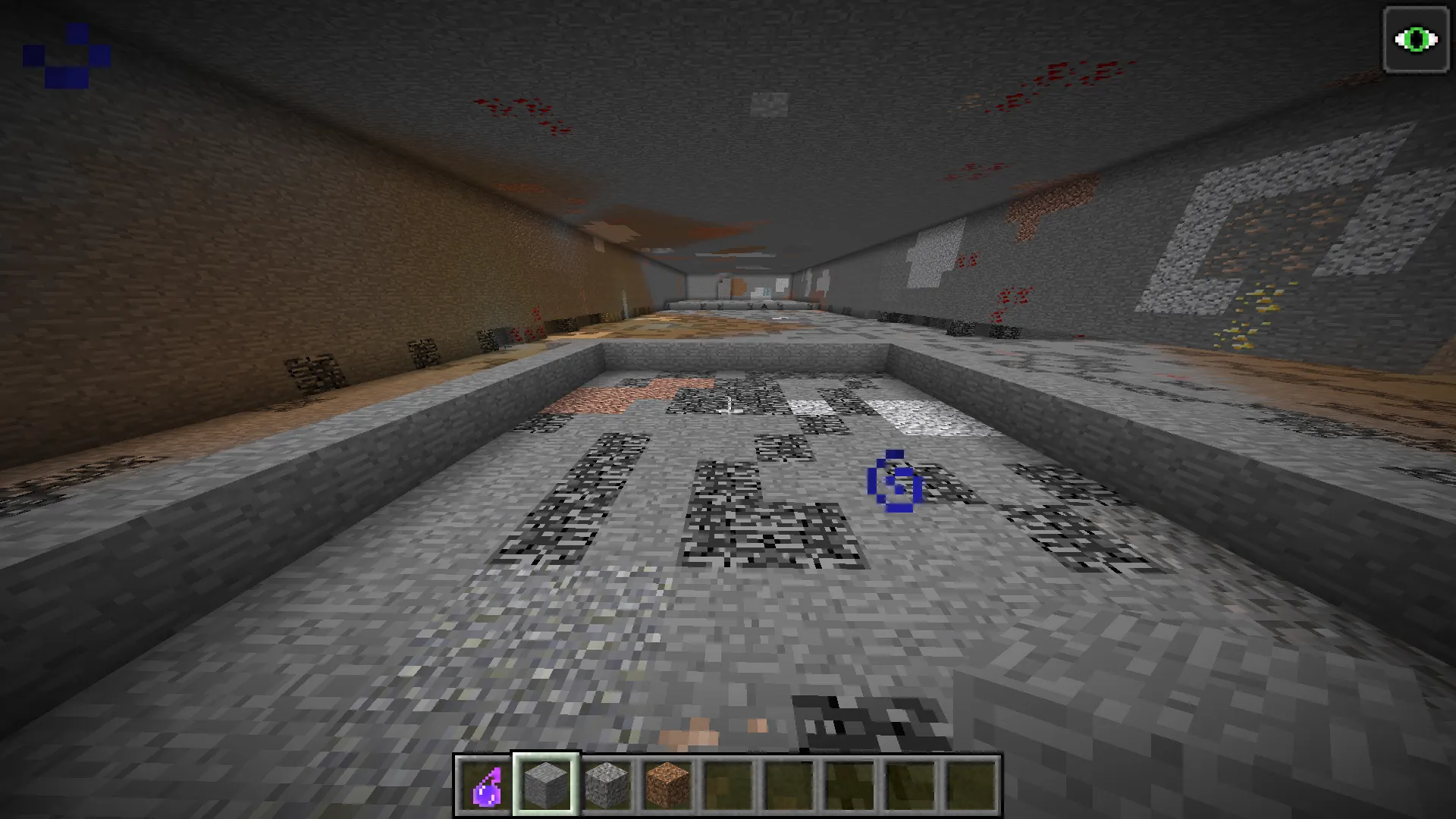
That is the player’s feet position from F3. The block the player is standing on is one block below that, so the coordinate wanted by the challenge was :
UDCTF{1375_4_522}Greetings
Thanks to the Blue Hens CTF organizers for this amazing challenge and CTF in general, it had a lot of really interesting challenges and I had a lot of fun solving many of the hard challenges, it has been a while since I saw a Minecraft challenge that I actually enjoyed solving.
References
- 2b2t Bedrock Finder by ChromeCrusher: https://gist.github.com/LuxXx/32b132a73e4073b9d2fe2544fb09a15d